STC wall Rating Calculator
This STC Wall Calculator is an easy-to-use tool designed to help you estimate the Sound Transmission Class (STC) rating of a wall assembly.
How our STC Wall Calculator works:
Whether you're designing a soundproof room for a home theater, recording studio, or reducing noise between rooms in a commercial space, this calculator will guide you in selecting the ideal materials and configurations to achieve your sound isolation goals.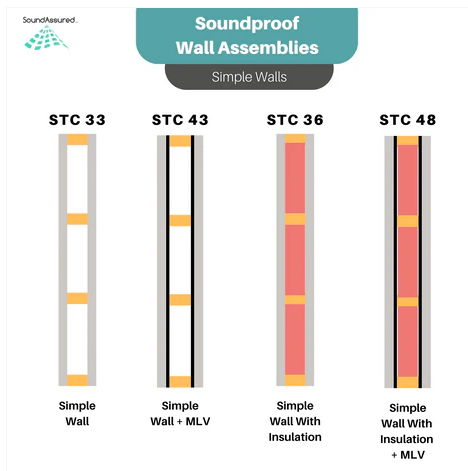 >
>
Image source: SoundAssured: What STC Ratings Mean
How to Use the STC Wall Calculator
To accurately calculate the STC rating of your wall design, simply choose from the following parameters:
- Drywall Layers: Select the thickness of the drywall used. The thicker the drywall, the better the soundproofing.
- Insulation Type: Choose the insulation materials that contribute to enhanced sound isolation, such as fiberglass, cellulose, or foam board.
- Stud Type: Indicate whether you’re using metal or wood studs. Different materials have different soundproofing characteristics.
- Stud Spacing: Set the spacing between studs. The greater the spacing, the more effective the sound isolation can be.
- Resilient Channel: This option involves adding a resilient channel to decouple drywall from studs, improving sound isolation.
- Sound Membranes: Choose additional soundproofing membranes that further reduce sound transmission.
After entering your selections, the calculator will provide you with an estimated STC rating for your wall assembly, helping you understand how well your wall design will attenuate sound.
Why STC Ratings Matter for Soundproofing
When designing walls for noise reduction, STC ratings are crucial for assessing how effectively a wall can block airborne sound. A higher STC rating means that the wall will block more sound. For example, walls with an STC rating of 25 allow normal speech to be heard, while walls with an STC rating of 60 or higher can significantly reduce sound transmission, making it almost impossible to hear loud sounds from the other side.
Real-World Applications of STC Ratings
STC ratings are crucial for various projects, including:
- Home Theaters: Achieving a high STC rating ensures that your entertainment area remains quiet and free from external noise.
- Recording Studios: For sound-sensitive environments, a high STC rating is vital to ensure clear, noise-free recordings.
- Residential and Commercial Spaces: Reducing noise between rooms in a house or office can improve comfort and privacy for residents or workers.
- Hotels and Apartments: Soundproofing walls are essential for creating peaceful, private spaces in multi-unit buildings.
STC Ratings Explained
The Sound Transmission Class (STC) is a standardized method for rating how well a partition—typically a wall—blocks sound. Here’s how to interpret STC ratings:
- STC 25: Normal speech can be easily understood on the other side.
- STC 30-35: Normal speech is not clearly audible, but loud conversations may be heard.
- STC 40-45: Loud speech is not intelligible, but sounds like TV noise might be heard faintly.
- STC 50-55: Most loud noises, including music and conversation, are completely blocked.
- STC 60+: Very high sound isolation, ideal for professional studios and soundproof rooms.
What Affects STC Ratings?
The STC rating of a wall depends on several factors:
- Material Density: Denser materials like concrete or mass-loaded vinyl block sound more effectively.
- Wall Construction: The configuration of studs, drywall layers, and the presence of soundproofing materials will impact the rating.
- Air Gaps and Voids: Gaps or voids in the construction can reduce the wall's effectiveness at blocking sound.
- Resilient Channels and Membranes: These materials reduce sound transmission by decoupling drywall from the studs.
FAQ: Common Questions About STC Ratings
What is the Sound Transmission Class (STC)?
The Sound Transmission Class (STC) is a numerical rating system that measures how well a building material, such as a wall or floor, attenuates airborne sound. Higher STC ratings indicate better soundproofing performance.
How Do I Interpret STC Ratings?
STC ratings generally range from 25 to 80+. A lower STC (below 30) means that sounds like normal conversation can be heard easily, while a higher STC (above 50) can block most noises, including loud voices and music.
Can I Achieve a High STC Rating with Any Wall Assembly?
Not all wall assemblies are created equal. To achieve high STC ratings, it is essential to select the right combination of materials and construction techniques. Using specialized soundproofing materials, like acoustic insulation and resilient channels, can significantly improve the sound isolation of your walls.
Can the STC Wall Calculator Be Used for Any Type of Wall?
Yes! The STC Wall Calculator is designed to accommodate a wide variety of wall configurations and materials. Whether you're designing a simple partition or a highly soundproofed wall, this tool will help you estimate the STC rating for your wall assembly.
Explore More Tools
Want to explore more tools? Check out our full collection of Aerodynamics calculators to enhance your learning and research.
Climb rate calculator