Understanding Ionization Energy and the Effective Nuclear Charge Model
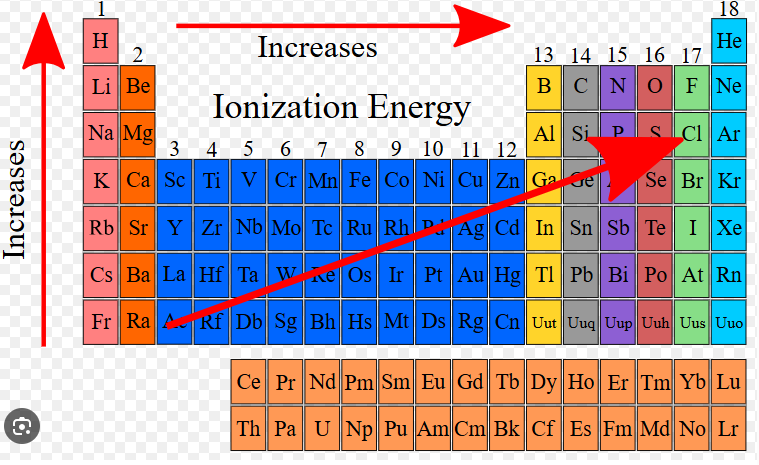
Ionization energy is the energy required to remove an electron from an atom or ion. In chemistry and atomic physics, it helps explain periodic trends, chemical reactivity, bonding behavior, and the stability of atoms.
This Ionization Energy Calculator uses a simplified hydrogen-like model. Instead of treating every electron interaction exactly, it estimates the attraction felt by the electron using an effective nuclear charge.
Here, Z is the atomic number and S is the screening constant. The screening constant represents the shielding effect of other electrons.
Ionization Energy Formula Used by This Calculator
The calculator uses the following hydrogen-like approximation:
The negative value represents the bound electron energy level. The ionization energy required is reported as a positive value:
The result is given in electron volts (eV).
Inputs Required
- Atomic Number (Z): The number of protons in the nucleus.
- Screening Constant (S): The shielding effect caused by other electrons.
- Principal Quantum Number (n): The electron shell or energy level.
Important Accuracy Note
This calculator is best understood as an educational approximation tool. It works well conceptually for hydrogen-like atoms and ions, but neutral multi-electron atoms require more advanced quantum models or experimental data.
For real atoms, the selected screening constant has a strong effect on the result. Treat the output as an estimate unless you are working with a hydrogen-like system or a carefully chosen effective nuclear charge.
Example Calculation: Hydrogen Atom
A clean example is hydrogen, because it has one proton and one electron, so there is no inner-electron shielding.
Given:


Z = 1
S = 0
n = 1

Step 1:
Zeff = Z - S
Zeff = 1 - 0 = 1

Step 2:
Elevel = -13.6 × Zeff² / n²
Elevel = -13.6 × 1² / 1²
Elevel = -13.6 eV

Step 3:
Ionization Energy = |Elevel|
Ionization Energy = 13.6 eV
This means approximately 13.6 eV is required to remove the electron from a hydrogen atom in its ground state.
Example Calculation: Effective Nuclear Charge Approximation
For a multi-electron atom, the calculator uses the screening constant to estimate the effective nuclear charge.
Assume:


Z = 11
S = 10.6
n = 3

Step 1:
Zeff = Z - S
Zeff = 11 - 10.6 = 0.4

Step 2:
Elevel = -13.6 × 0.4² / 3²
Elevel = -13.6 × 0.16 / 9
Elevel = -0.24 eV

Step 3:
Ionization Energy = |Elevel|
Ionization Energy = 0.24 eV
This example shows why the choice of screening constant matters. The simplified model can be useful for understanding trends, but it should not be treated as exact experimental data for real multi-electron atoms.
Where Ionization Energy Is Used
- Chemistry: Understanding periodic trends, bonding, and chemical reactivity.
- Atomic physics: Estimating electron binding energy in simplified models.
- Plasma physics: Understanding when atoms or gases become ionized.
- Astrophysics: Interpreting ionization states in stars and gas clouds.
- Mass spectrometry: Understanding how atoms and molecules ionize during analysis.
Common Mistakes When Calculating Ionization Energy
- Using the wrong sign: Bound energy levels are negative, but ionization energy required is usually reported as positive.
- Using an unrealistic screening constant: If S is too large or too small, the result can become misleading.
- Assuming the model is exact: The formula is a simplified approximation, not a full quantum-mechanical solution for all atoms.
- Using non-integer quantum numbers: The principal quantum number n should be a positive integer.
- Allowing S to exceed Z: The effective nuclear charge should remain positive in this simplified model.
Frequently Asked Questions
What is ionization energy?
Ionization energy is the energy required to remove an electron from an atom or ion. It is commonly measured in electron volts (eV) or kilojoules per mole (kJ/mol).
Why does the calculator use effective nuclear charge?
In multi-electron atoms, outer electrons do not feel the full nuclear charge because other electrons partially shield them. Effective nuclear charge approximates the net attraction felt by the electron.
Why is the energy level negative?
A negative electron energy level means the electron is bound to the atom. To remove the electron, energy must be supplied, so the ionization energy is reported as a positive value.
Can this calculator be used for every element?
It can be used for educational estimates, but it should not be treated as exact for every element. Real ionization energies for multi-electron atoms depend on electron configuration, quantum interactions, and experimental data.
What is the screening constant?
The screening constant represents the shielding effect from other electrons. A larger screening constant lowers the effective nuclear charge and usually lowers the estimated ionization energy.
What does the principal quantum number represent?
The principal quantum number, n, describes the electron shell or energy level. Electrons with higher n values are generally farther from the nucleus and less tightly bound.
How accurate is this ionization energy calculator?
It is accurate as a simplified hydrogen-like approximation. For precise ionization energies of real atoms, especially heavier elements, experimental data or more advanced quantum calculations are required.